I ran a task through Microsoft Copilot Cowork last week that cost me $13. I was shocked.
What did I asked Cowork to do?
At Creaspark, we use the EOS business management framework, as each quarter we host a quarterly business review (QBR). Our QBR’s run about eight hours, and we capture the whole thing as one long Teams recording and transcript.
I wanted assistance building executive briefing summary, a real Word document we could use to summarize the entire day, what we discussed, our updated priorities, todos, etc.. This is the kind of work I would normally give to an assistant and expect back the next day.
Cowork handled it well. It found the transcript in my tenant without any fuss, read the whole thing, and drafted an outline for the briefing. I approved the flow, made a couple of small changes, and asked it to build the document. About ten minutes later it had written a clean file straight into my OneDrive. The first pass did not follow my general Cowork instructions, so I gave it my formatting examples and it rebuilt the document. The result was good. Copilot or Claude should have been able to give me similar results, though I saw this more of as task that should store input and output data, thus Cowork.
Then I ran `/cost`
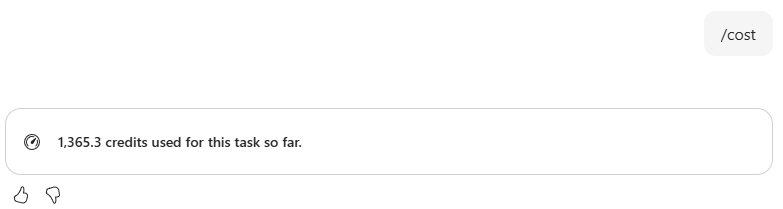
1,365 credits. Over thirteen dollars for one document.
Sit with that for a second, because my reaction was not really about the thirteen dollars. The value was there. If I had built that briefing myself it would have been four to eight hours of work, so the document was worth far more than thirteen dollars in labor. That math is easy. Microsoft could show ROI.
The reaction was that I only saw the number at the end. There was no price at the moment I decided to run the task, only an invoice at checkout. And underneath that, a more uncomfortable fact: my existing subscriptions would have done nearly the same thing at no additional cost. My Claude plan writes Word documents. Copilot could have gotten me most of the way there with a little copy and paste and even a Word document to download. I already pay for both.
So thirteen dollars is not expensive in a vacuum.
It is expensive against a substitute I already own. And that is the whole story I want to tell.
Not the cynic, not the cheerleader, and not the bubble question
Two camps own the AI conversation right now.
The cynics say AI is not worth it and the whole thing is a bubble waiting to pop. The cheerleaders say the agentic future is already here, it is going exponential, and it is getting cheaper by the month.
I do not sit in either of these big camps, and to be fair, there is a third position I am also not taking. There is a real argument about whether the industry’s spending ever pencils out, whether the circular financing between chipmakers, clouds, and model labs ever produces a return. That is a genuine question and it is a separate one. I am not here to tell you whether the frontier labs are a good investment. That is above my pay grade and beside my point.
My point is smaller and more practical
The value is real, and the cheap access was the illusion.
Real tool, subsidized price.
I say the value is real because I live on it. I run agents that aggregate my email and hand me the highlights I actually need to act on. I track compliance across several ventures, the filings due to state, federal, and county authorities, with AI keeping me ahead of the deadlines. I write with it every day. One of our big organizational objectives this quarter is tied directly to accelerating AI value both internally and externally, because I believe it will help.
Notice what all of those have in common. They are bounded jobs or they keep a human in the loop, and every one of them runs inside a flat, predictable subscription. None of them is a thirteen dollar unbounded agentic run. The AI that works for me today is the AI that fits inside a known cost boundary. The moment I stepped outside that boundary, it stopped being worth it, or at least challenges the cost to value.
That is not a complaint about AI. It is a clue about its economics.
The question nobody is framing right
Listen to the people running large companies and you hear a chorus about price. Palo Alto Networks CEO Nikesh Arora told CNBC that token prices need to fall by as much as 90% before enterprises can deploy AI at scale. Palantir’s Alex Karp, on the same network, said of the per token model that “something has gone completely wrong.”
Their proposed fix is always the same. Make tokens cheaper. Efficiency, price wars, custom silicon.
But here is the puzzle they skate right past. Token prices have already collapsed, and total bills have gone up anyway. Everyone is solving for a number that has been falling for years while the thing that actually hurts keeps climbing.
So the real question is not “will tokens get cheaper.” They will. The real question is “why does my bill go up while the price of a token goes down.” Answer that, and you can see where all of this is heading.
The two wells
Think of your AI spend as two separate wells you are drawing from.
The first well is the cost per token. How many cents does it take to produce one unit of output. This well is deep. It keeps getting cheaper through better software, smarter systems, and purpose built chips. This is the well everyone points at when they say AI is getting cheaper, and they are right about it.
The second well is the number of tokens it takes to finish a task. This one has a floor. A real job requires a real amount of work, and you cannot reason your way below it. You can trim waste once, but the irreducible core of a hard task needs the tokens it needs.
Your bill is the first number multiplied by the second, multiplied by how many tasks you run. And agentic AI hammers the second and third. Gartner puts it plainly: an agentic workflow burns five to thirty times more tokens per task than a simple chatbot query, because it reasons in steps, calls tools, checks itself, and tries again.
Now here is why the falling cost of the first well never seems to reach you. The savings get captured twice before they get to your bill.
They get captured by the frontier ratchet. Every efficiency gain arrives dressed as a better model, not a cheaper one, and we all move (forced to move) to the better model. The cheap older tiers get pulled out from under us. Gartner’s own analyst, Will Sommer, described this to CIO Dive: as models grow more complex, they require more tokens (we are seeing some efficiency gains that has a shallow floor) that are more expensive relative to the older ones. You are never allowed to sit still on the model that just got cheap.
And they get captured by the people who run the most. Committed heavy users break the flat rate average, and agentic workloads turn ordinary users into heavy ones.
There is a good faith counterargument here. Algorithmic efficiency is genuinely deflationary. Distillation, mixture of experts, and open weight models landing near the frontier are all real, and they push cost down hard.
Even still, they do not refute the argument. They live inside it. A cheap near frontier model is good enough for the routine steps and not good enough for the reasoning core, because multi step work compounds error, and suppressing that error is exactly what frontier grade reasoning is for.
The cheap models suppress price at the routine tier, which is precisely where they belong. The expensive reasoning stays expensive.
Gartner said the quiet part out loud. Chief product officers, in Sommer’s words, should not confuse the deflation of commodity tokens with the democratization of frontier reasoning. The cheap stuff gets cheaper. The reasoning that agents actually depend on stays scarce.
Why this is a floor and not a blip
You could dismiss all of this as a temporary business choice. Subsidies get pulled, prices adjust, the market sorts it out, and in two years we are back to cheap. If the story were only about pricing strategy, that would be a fair rebuttal.
It is not only about pricing strategy! There is a physical floor under this, and it is made of memory.
Every modern AI accelerator pairs a logic chip with high bandwidth memory, or HBM, stacked directly on the same package. No HBM, no usable accelerator, no matter how many raw chips the foundries print. And HBM has become the binding constraint on the entire industry. GPU fabrication scaled up. The memory that has to sit next to those chips did not keep pace, because stacking memory dies with through silicon vias is genuinely hard to scale, even with enormous capital thrown at it.
And yet, there is a second chokepoint right behind it. The advanced packaging that assembles the logic chip and the memory into a finished accelerator, called CoWoS, is also sold out! TSMC has said as much directly. So even when the memory exists, the finished part cannot be assembled fast enough.
That is a pass through the pricing optimists are missing.
Constrained memory constrains how many inference chips can actually be built and deployed. Constrained deployment, running into rising agentic demand, holds the price of inference up regardless of how clever the algorithms get. Efficiency does not manufacture HBM stacks or packaging capacity.
And the timelines are not short, these bottlenecks are not going to be solved as fast as too many are saying. The manufacturers themselves describe this as the most prolonged shortage in the industry’s history, with three to five years needed to fully catch up. New fabs realistically take years to bring online, and the specific facilities being built come online anywhere from late 2026 through 2030. I lean towards the end of that horizon.
My own read is more pessimistic than those dates suggest, and here is why. Company timelines tend to be optimistic, particular those with stock prices to raise. Two to four years is a very long time in this industry, long enough for a few full model generations. And supply is chasing a demand target that keeps moving, which means capacity sized for 2028 demand may already be short the day it opens.
What matters is most to me here is, the one thing every analyst agrees would actually end the shortage is AI demand cooling off.
I don’t see that happening, that is not being reliably forecasted. The pressure holds.
To be fair, the memory floor supports the argument, while not carrying it alone. Even if the shortage eased tomorrow, the two wells and the frontier ratchet would keep the pressure on. The memory crunch is what makes the pressure undeniable and dated, not what makes it exist.
Every exit runs back through the same wall
If the cost is real and durable, the natural move is to look for a way out. I see three doors, and they all open onto the same wall.
The first door is to ration inside a subscription. This was my refuge, and it is already closing. One of the model providers I use quietly re-geared how its credits refresh partway through my subscription. I did not get a price increase. I got a smaller plate. My multi-agent setup, which had been running comfortably, hit a wall in a single day. Microsoft made the true cost visible with a meter via Cowork. This provider made it visible by shrinking what my flat fee buys. Same force, quieter delivery. Hardware costs got in the way.
The second door is to pay the meter. That is predictable only in the sense that it will hurt, and you will feel it the way I felt my thirteen dollars. Often after the fact. Particular when end users are involved. Hardware costs are driving the token price.
The third door is to own the hardware and run models locally. A strong open weight model on a top end single machine will run, silently, off a wall socket. But do the math honestly before you count on it. A serious dense model on a reasonable single box (say a Apple M3 Ultra with 256GB ram) tops out somewhere around a million output tokens in a day running flat out (i.e. sustained ~12 output tokens per second for a strong open weight model on an M3 Ultra, 12 × 60 × 60 × 24, or about 1.04 million tokens), and that number moves with hardware, model size, and quantization. Long inputs bring their own penalty, because digesting a big prompt before the first word comes out is slow. And the hardware itself is getting scarcer (I want my M3 Ultra with 512GB!) and pricier as the same memory shortage continues. The upfront cost may well eat the savings, and you have to run that calculation for your own workload rather than assume it.
Notice the pattern. Every escape from the meter runs back through memory, and memory is exactly what is scarce. There is no configuration where the constraint does not eventually find you.
My next stake in the ground
We are not in an AI bubble about to burst. A burst is what happens when the value was never there (pets.com, mortgages backed by no method to repay, etc). That is not this. My thirteen dollar briefing was worth far more than thirteen dollars, and I would not give up the agents I run for anything. The usefulness is not in question.
It is a repricing. Cheap AI was a subsidy, not a baseline.
The clearest picture of that for me came from a Wall Street Journal report on the founders being showered in free compute, where one builder admitted he picks the expensive model he gets for free over the cheap one he would have to pay for. That is the anomaly in plain sight. Buyers are not choosing the true low cost option. They are choosing whoever is subsidizing them.
As those subsidies thin and the real cost of the inputs shows through, access re-tiers by who can afford to run AI continuously. This is not a forecast anymore. It is already happening at the hardware layer, where the clouds and frontier labs with capital to pre pay for memory allocation have secured priority, and everyone smaller waits longer and pays more.
The years where AI was cheap for everyone were the anomaly. What follows is more stratification, not less. The token price may well fall the ninety percent Arora is asking for, and your agentic bill still may not move, because the savings keep getting spent on capability you do not get to opt out of.
What to actually do about it
The response is not a product you buy. It is a posture you adopt.
Stop being a price taker who is waiting for tokens to get cheap. They will get cheaper and it will not rescue you, so build as if AI is expensive, because for the work that matters it is and it will stay that way for years.
Map each kind of work to its right home. The mechanical steps, the fetching and formatting and routing, do not belong in a model at all. They belong in deterministic code you own, running at no marginal cost. The routine but fuzzy steps can go to a small or local model, if the math works for your workload. And the frontier meter gets reserved for the genuine reasoning you cannot reproduce any cheaper.
This is not a fringe idea. It is more or less what Gartner is telling its own clients: route routine high frequency work to smaller models, and gate expensive frontier inference for the complex reasoning that justifies it. Once you see your bill as tokens per task times the number of tasks, spending frontier tokens on plumbing is simply waste.
The local path in particular is not a free lunch. Owning the hardware means owning the capital cost, the model lock in, the maintenance, and the thing that breaks at two in the morning with no vendor to call. Size it with a spreadsheet, not a slogan.
I am betting that demand does not cool. Not that it explodes the way the loudest voices promise, because good agents are genuinely hard and expensive to build, and I think that hype is overblown. Rather demand grows, steadily and for real, through the committed users who put in the work.
Here is the twist: slower, harder adoption is worse for the subsidy, not better, because the people who actually show up are the heavy users who break the flat rate average. The subsidy needs a crowd of light users to pay for the few who run hot. Agentic AI turns everyone who sticks with it into someone who runs hot.
The winners of this repricing will not be the ones with the biggest budgets. They will be the ones who built for expensive AI before they were forced to.







Speak Your Mind